
Let me start off by saying this is a longer read. Like, a reallllly long read. Partly because AI in product photography is complicated, and partly because I want to be honest about where it helps and where it falls apart. I think it’s worth it, but, if you’d rather skip to the quick version, there’s a TL;DR at the bottom.
I’ll be honest. I’ve been resistant to AI for product imagery for a long time. When it first came on the scene a friend asked me what sorts of things I’d been creating and I shut them down cold. Part of me was worried about how it fits with authenticity for brands, and whether it undermines the trust that comes from showing a real product in a real space (still is.) Part of me was angry that AI was “coming for my job (still am.) But over time I’ve realized that some brands are going to use AI for certain situations whether I like it or not. Instead of ignoring it, I wanted to understand where it could actually support brands, and where it shouldn’t.
I still believe the best results come from hiring a professional photographer, but AI can sometimes be a useful support tool when guided by someone who understands how real photography works. The tools themselves are impressive, and they are getting better every day. You’ve probably seen generated mockups, faux-studio shots, or fully imagined campaign scenes (hello Coca-Cola, Nike, and Benneton.) But here’s the thing: AI does not replace the need for a good product photographer. You still need someone who understands light, composition, brand personality, and the physics of real objects before an image becomes something a brand can confidently use.
So here is how I’m shifting my mindset: instead of treating AI as competition, I’m looking at where it might expand possibilities (and where it clearly doesn’t.) In the film era people saw digital cameras as “cheating” - something that was trying to take their jobs and make “real” photographers obsolete (sound familiar?) But digital opened up the ability to move faster, cheaper, and experiment more. Kind of like AI. It can help brands move faster, explore ideas that would be too expensive to build in real life, and support content needs that have impossible timelines. But the same as using a digital camera, AI only works well when a photographer is directing it with intention. Without that guidance, the results often fall short of what a brand truly needs.
The Photographer’s Brain Behind the Machine
Most people think if you type enough words you should be able to unlock the perfect image. They think that if they describe every detail the model will produce the exact scene they imagine. What actually happens is the opposite. The more text you throw at a prompt, the more confused the tool becomes. Specific does not always mean clear, especially when the direction is coming from someone who has never lit a product in a real studio or thought about how objects behave under real light.
Good AI results come from the same thinking that shapes good photography. You need an art director’s eye and a photographer’s understanding of physics. You need to know how a can reflects a strip light. You need to understand what angle makes a label feel intentional. You need to know how far a hand can realistically bend before it becomes uncanny. Prompts are not magic. They are direction. The quality of that direction depends entirely on how well the person guiding the process understands lighting, composition, materials, and the tools that would be used in a real studio. This is why some people get consistent, refined images that feel on-brand, and others get melted cans, impossible shadows, and hands with backward thumbs.
When a professional photographer approaches AI, the results suddenly feel logical and believable. When someone without that background approaches AI, the results often look like the machine threw the ingredients into a blender and hoped for the best. It is not about typing more words. It is about giving the AI the same clarity you would give a real crew on set. That is where realism comes from.
Where Real Photography Ends and AI Begins
There are some things AI still doesn’t do well. Complex textures, transparency, real imperfections (not the same as AI flubs,) text without gibberish (hello misspelled brand logo!) proportions, consistency. These are the elements that make people believe what they are seeing. For hero images, campaign anchors, or anything that needs real trust, even for the images of your product that you feed into AI to create something new, real photography still does the heavy lifting.
But AI has its occasional place - specifically as a support tool. It can build test concepts, help visualize packaging design before printing, generate complex scenes that would cost a fortune to produce by hand. It can provide one off assets that are not meant to carry a whole brand but still need to feel on-brand. Need a shot for your Super Bowl promotion? One to remind people your product makes a good valentine’s gift? AI is best when it capitalizes on what’s possible, not when it pretends to replace the real thing.
Fast Visuals Without Losing Brand Integrity
Speed is the biggest reason brands turn to AI, but the other driver is cost, or, more accurately, the perceived cost. Both of these perceptions come at a cost themselves. AI feels “free” once you’re already paying for the tool, while a photoshoot feels like an investment. But the truth is that bad AI costs more in the long run. If a generated image looks off, people feel it. They may not be able to name the issue, but they will sense the discomfort, and that discomfort quietly chips away at trust.
A photographer can prevent this. When I use AI in my workflow, I treat the real product as the source of truth. I match lighting logic, refine highlights, and keep the details consistent across a full set. The result is content that moves as fast as the brand needs and stays within a realistic budget, while still protecting the product’s integrity.
When AI Breaks Down
Anyone who has experimented with AI tools has seen the usual suspects. Fingers that multiply, hands that bend like origami, liquid that behaves in ways that would confuse a physicist. The other day a client brought me an image to edit that had an extra set of teeth in the model’s mouth!
These are the obvious issues, but there are less obvious ones that likely only a trained eye will spot:
Shadows that make no sense
Warped, bent, or stretched logos and text
Product shapes that do not match the real item
Colors that drift from your brand palette
Unnatural reflections, especially on glass
Spots, dust, or noisy areas
Fabrics that feel like plastic
Edges that feel too smooth or too sharp
Details that subtly change from image to image
Overexposed or harsh lighting
“Impossible” backgrounds
These issues might seem tiny, but they are the difference between something that looks premium and something that looks like a placeholder. A photographer sees these things immediately, AI does not.
Why AI Images Still Need Real Retouching Skills
Even when AI produces something halfway decent, it is almost never ready to use as-is. You still need someone who can bring the file into Photoshop and clean up the issues that the AI model cannot solve. Product proportions drift, edges look strange, labels need sharpening, structural defects need to be fixed, colors need to be matched to the real packaging, etc. Without these adjustments, the image looks slightly off and you risk a loss of trust and damage to the brand reputation.
Retouching is where a photographer’s experience becomes essential. You need someone who knows what the product is supposed to look like in real life and who can use traditional editing tools to bring that realism back. AI can get you part of the way there, but finishing the job still requires the same hands-on craftsmanship that has always been part of professional product photography.
The Hybrid Workflow That Gets the Best of Both Worlds
The sweet spot is a hybrid approach. Hybrid doesn’t mean replacing products with AI versions. It means using AI to augment real images. Real photography anchors the brand with accuracy and trust; AI steps in when a brand needs speed, concept visualization, or scenes that would be too expensive or impractical to build by hand.
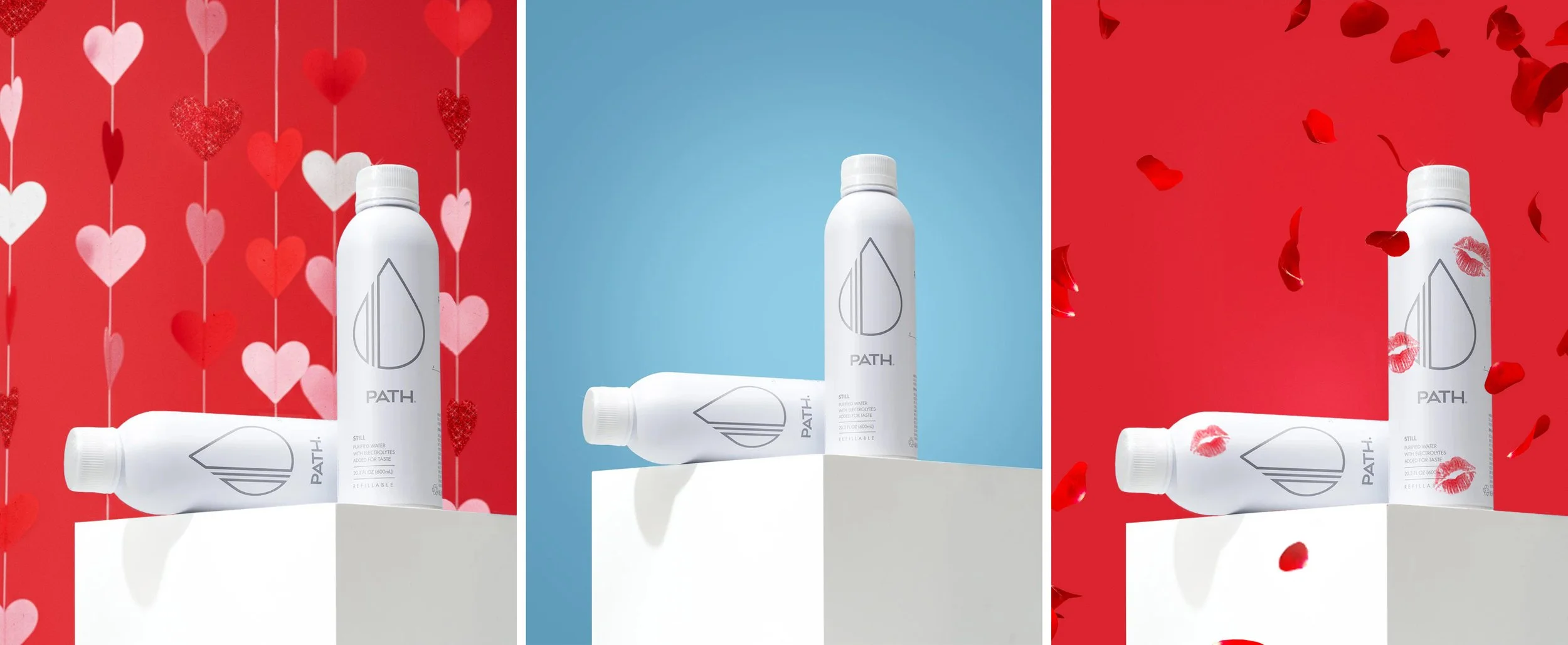
One of the most useful hybrid applications is giving existing photography a quick, seasonal twist. Instead of booking a full shoot every time a holiday or event comes up, AI can take a clean hero shot from your existing library and give it a seasonal twist. Kind of like swapping out the pillows on your couch at Christmas time. You get fresh, timely content without investing in new props, and hours of prep and shooting for a one day promotion, and your shot looks on-brand in a way that your customers find familiar. In this workflow, photography and AI are not competing. They are supporting each other. It saves time and money, and keeps your visuals consistent because the base image still comes from real photography. It’s a flexible system that helps you create more without lowering your standards.
So Where Does This Go Next
AI will keep improving, and so will the ways brands use it, but I firmly believe what will not change is the need for a trained eye guiding the process now matter how the tools evolve. AI is changing the technology generating the pixels the same way the digital camera changed the tool used to capture light. You still need a photographer directing the shoot. When used with intention, AI becomes not a replacement, but a collaborator that works best under the direction of someone who understands how images actually function. I believe there is room for both to live together in a thoughtful and strategic way.
I also want to acknowledge the environmental concerns around AI because it’s a part of this conversation too. These tools aren’t weightless - they require significant energy to run, and that impact matters. That’s one of the reasons I’m not interested in pushing AI as a replacement for photography or churning out endless variations just because it’s “easy.” But real-world production has a footprint, too: shipping product, buying props and materials, producing packaging samples, and building physical sets all create waste, especially in the food and beverage categories. The goal isn’t to claim one method is “better,” but to use the right tool for the right need. When I use it, I try to use it intentionally and with restraint: to reduce waste instead of creating more of it. As with everything in creative production, sustainability comes from taste and intention, not from the tool itself.
If you want help experimenting with AI for your brand or exploring hybrid workflows that protect your visual identity, I am happy to talk through options.
TL;DR — When AI Meets Product Photography
I’ve been resistant to AI for product imagery, partly because I worry about authenticity and partly because it felt like it was “coming for my job.” But some brands will use it no matter what, and I’d rather help them use it well than ignore it.
AI does not replace a product photographer. It still needs someone who understands lighting, materials, composition, and how real products behave in real space.
More words don’t make better prompts. Clear art direction and photographic logic do.
AI still struggles with realism: textures, transparency, labels, consistency, proportions, and anything involving hands, text, or reflections.
Even good AI images require real retouching. Photoshop is still where realism gets restored.
Brands turn to AI for speed and the perceived lower cost, but bad AI costs more in the long run because tiny inconsistencies erode trust.
Hybrid workflows are where AI shines. Real photography anchors the brand. AI supports it with:
quick seasonal or event-based variations
concepting and visualization
scenes that would be too expensive or impractical to shoot
AI can stretch existing assets without requiring a full production - great for one-off promotions like Valentine’s Day, the Super Bowl, etc.
Sustainability matters. AI uses real energy, and real shoots create physical waste. The goal isn’t choosing one “better” method but using each tool with intention. (For more on AI and its environmental impact read this article here.)
Bottom line: AI is a collaborator, not a replacement. Photography still does the heavy lifting, and a trained eye is what makes either tool work.